
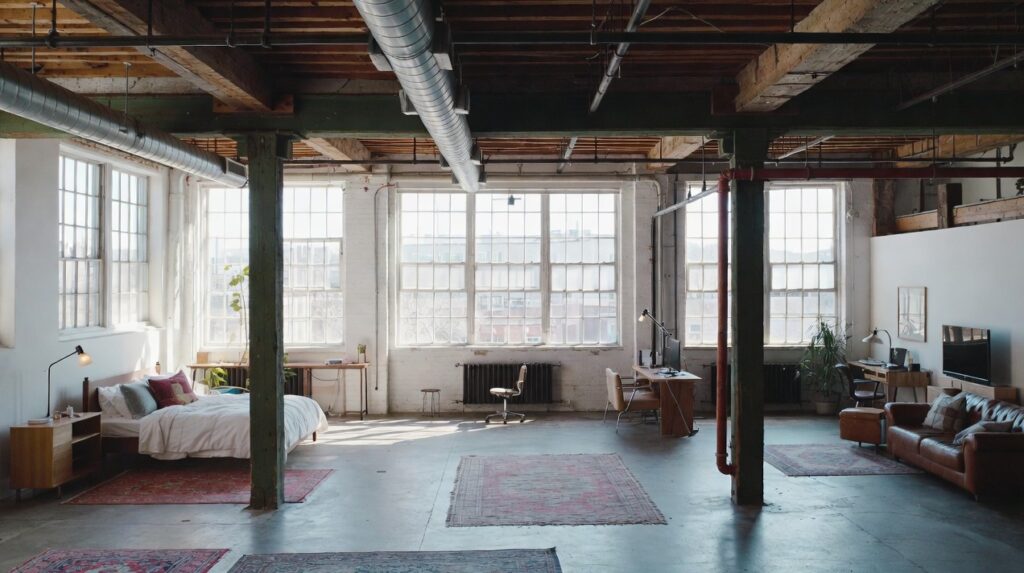
There is a raw, undeniable romance to the converted industrial loft. Housed in former factories, warehouses, and breweries, these spaces carry the ghosts of the city’s working past. They are cathedrals of commerce, now reimagined as homes, and they attract those who crave something different from the standard apartment layout. The appeal lies in the bones of the building itself: the weathered brick, the heavy timber beams, the enormous steel-framed windows, and the sense of boundless, open space.
The first and most exhilarating challenge of loft living is the absence of interior walls. While this openness is the defining feature, it can also be daunting. How do you create a sense of intimacy and define separate areas for sleeping, eating, and relaxing in one giant room? The key is to think in terms of zones rather than rooms. The placement of furniture becomes an architectural act. A large, low sofa can anchor the living area, its back facing the kitchen to create a natural division. A substantial area rug defines the dining space, pulling chairs and table into a cohesive island of activity.
Sleeping in a loft requires a particularly thoughtful approach, as privacy is often minimal. For those who prefer a completely open plan, the bed becomes a sculptural piece of furniture, a curated island in the vast space. A beautiful, four-poster frame or a platform bed with a striking headboard can make the sleeping area feel intentional and special. For others, a need for separation leads to creative solutions. Freestanding partitions—such as a large bookcase, a panel of frosted glass, or even a grid of hanging plants—can visually screen the bed without blocking light or closing off the space entirely.
The massive windows that make lofts so desirable also present unique challenges and opportunities. Often spanning from floor to ceiling, they flood the interior with light but can also lead to significant heat loss in winter and heat gain in summer. Modern adaptations often involve installing discreet, roller shades or floor-to-ceiling curtains that can be drawn for insulation and privacy. The treatment of these windows must respect their scale; heavy drapes can overwhelm the space, while sleek, minimal coverings allow the architectural feature to remain the star.
Celebrating the industrial heritage is at the heart of the loft aesthetic. Rather than covering up the original elements, the most successful loft designs highlight them. Exposed brick walls can be sealed to prevent dusting and left in their natural, warm state. Original concrete floors can be polished to a smooth, reflective shine that is both durable and beautiful. Ductwork and sprinkler systems, often hidden in conventional homes, are left exposed and sometimes even painted to become graphic, linear elements on the ceiling, telling the story of the building’s past life.
Ultimately, adapting an industrial space for living is a collaborative dance between the occupant and the architecture. It requires a willingness to live differently, to embrace openness, and to honor the history embedded in every beam and brick. The reward is a home of unparalleled character and scale, a space that feels both monumental and personal. In a loft, you are not just renting an apartment; you are becoming the latest chapter in the long, rich story of an industrial building, transforming its past purpose into your present-day lifestyle.